
Clay County Court Records After Arrest
Clay County court records after an arrest are not the same record as the sheriff's booking entry. The Clay County Sheriff's Office says it completes booking reports, bonding reports, fingerprint records, photograph records, criminal-history work, and warrant service. Those records help answer custody, bond, and booking questions. Filed court records answer a different set of questions: what charge was put before a judge, which court has the case, whether a warrant or preliminary hearing occurred, and what disposition was entered.
The local court path is office-centered because Clay County does not publish a public case-search form on its county court pages. The Clay Superior Court Clerk is the local custodian for Superior Court criminal files once a case has been filed. Clay Magistrate Court handles minor criminal matters, arrest and search warrants, summonses, and preliminary hearings. A person looking for the booking side should use the Clay County jail inmate records page, while booking-photo questions belong with Clay County jail mugshots.
Find Clay County Court Records
The most direct source for filed Clay County court records after a jail arrest is the clerk or court that keeps the file. Superior Court criminal records are kept through the Clay Superior Court Clerk at 210 Washington Street South, Suite 3, Fort Gaines, GA 39851. The clerk's phone is (229) 768-2631, the fax is (229) 768-3047, and the published office hours are 8:00 a.m. to 4:30 p.m. Monday through Friday. The clerk page lists criminal, civil, juvenile, real estate, and Board of Equalization appeal-administrator work, so a request should identify the criminal case or arrest clearly.
Magistrate Court is the right Clay County court contact when the question is about an arrest warrant, search warrant, preliminary hearing, summons, or minor criminal matter. Its office is at 210 Washington Street South, Suite 5, Fort Gaines, GA 39851. The phone is (229) 768-2841, the fax is the same clerk fax, and the hours are also 8:00 a.m. to 4:30 p.m. Monday through Friday. Magistrate Court does not hold jury trials, so a felony case may start with warrant or first-stage activity there and then move into Superior Court records.
The Georgia Courts e-filing chart lists Clay Superior Court in the PeachCourt e-filing system, and PeachCourt can matter for filing access. It should not be treated as a jail arrest search. FANS is a filing activity notification system, not a custody tool. re:SearchGA may help with statewide court-record access where data is available, but the local clerk remains the official custodian for filed Clay Superior Court records.
- Start with the person's full legal name, date of birth if known, and approximate arrest date.
- Call the Superior Court Clerk for filed felony or Superior Court criminal case records.
- Call Magistrate Court for warrant, preliminary-hearing, summons, or minor criminal questions.
- Ask whether a case number, docket entry, bond order, accusation, indictment, or disposition has been filed.
- Use PeachCourt, FANS, or re:SearchGA only as supplemental court-access tools, not as the official Clay jail record.
The official Clay Superior Court page shows the local clerk contact used for criminal court records.
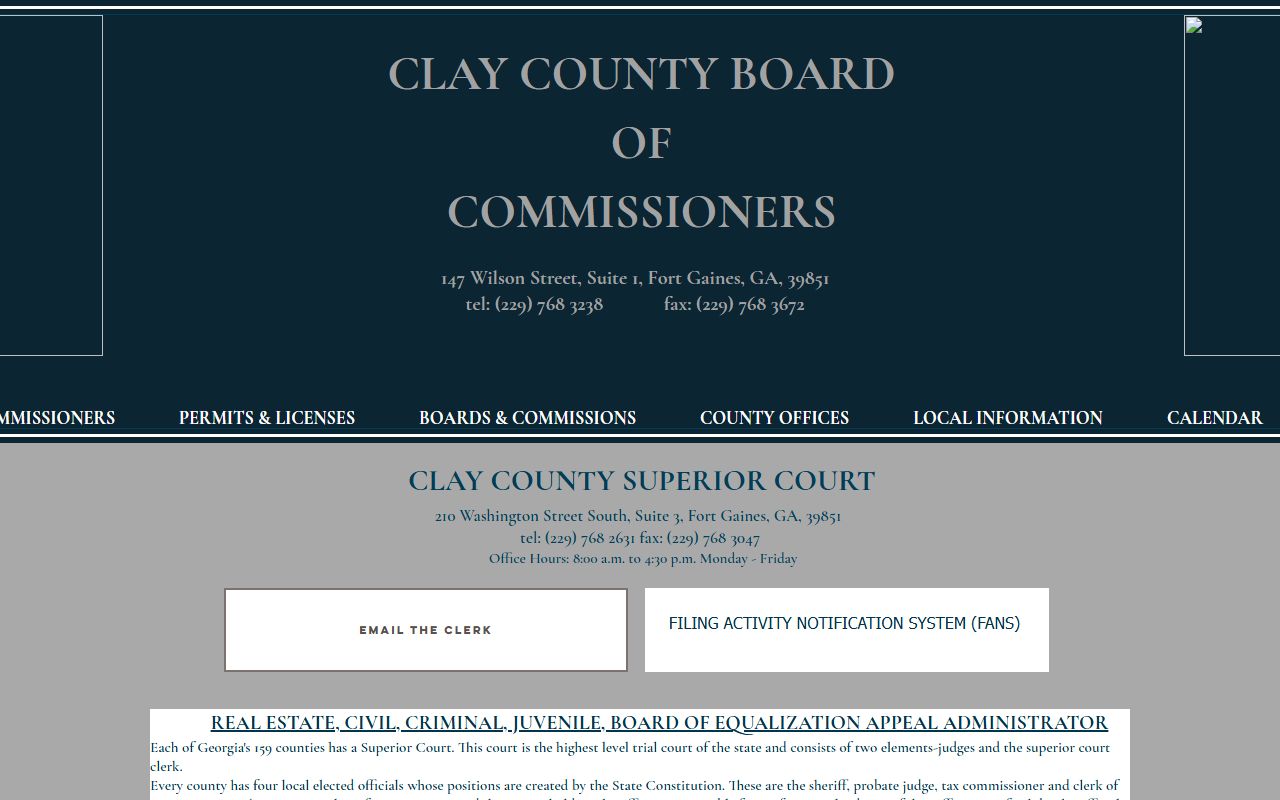
That source is why filed case records are routed to the clerk rather than to a jail roster or a state offender search.
Clay County Arrest Charge Records
After a Clay County arrest, the first label a family member hears may be a booking charge or warrant basis. That label can change. A prosecutor may file a different charge, reduce a charge, add counts, dismiss a count, or wait for a grand jury. Clay County is part of the Pataula Judicial Circuit, and felony prosecution is handled through the District Attorney's Office in Blakely. The DA is Ronald "Vic" McNease Jr.; the office address is 12850 Magnolia Street, Blakely, GA 39823; the phone is (229) 724-3011; the fax is (229) 724-3015; and the published email is rmcnease@pacga.org.
Charging-document names can vary by court and case type. The key point is practical: a booking report records the arrest event, while the charging document opens or advances the court case. For Clay County court records after an arrest, ask the clerk whether a formal accusation, indictment, warrant proceeding, bond order, docket entry, or disposition exists. If the clerk cannot discuss prosecution decisions in an active felony case, the Pataula Judicial Circuit District Attorney may be the next office to identify the status that can be released.
| Complaint or Warrant | Accusation or Information | Indictment | |
|---|---|---|---|
| Filed By | Law enforcement, court, or prosecutor depending on the step | Prosecutor | Grand jury through the court process |
| Common For | Arrest basis, warrants, first-stage criminal matters, and some misdemeanors | Many prosecuted criminal counts where an accusation is used | Felony matters that proceed by grand jury |
| Record Custodian | Sheriff for booking record, Magistrate Court for warrant proceeding | Superior Court Clerk after filing | Superior Court Clerk after filing |
| What It Starts | Custody event or early court proceeding | Filed criminal case or formal filed count | Filed felony case or formal grand-jury count |
Clay County Charge Status
Charge status is one of the most common points of confusion after a Clay County jail arrest. A person may be booked on one charge, appear in Magistrate Court on a warrant or preliminary-hearing issue, and later have a different filed charge in Superior Court. A court record can also show a charge as pending even after the person leaves custody. Release from jail does not mean dismissal. A bond order does not mean conviction. A transfer does not mean a new charge.
When reading court records after an arrest, check each count rather than only the top line of the case. One count can be pending while another is dismissed. A filed charge can be amended or reduced. A nolle prosequi entry means the prosecutor is not pursuing that count at that point, but the exact legal effect depends on the record and case posture. For public use, the safest reading is to verify the docket and disposition with the clerk before relying on the status.
| Status | What It Means |
|---|---|
| Pending | The charge has not reached final disposition in the filed court record. |
| Amended or Reduced | The filed count changed after review, plea discussion, hearing, or court order. |
| Dismissed | The count was ended by court action or case disposition shown in the record. |
| Nolle Prosequi | The prosecutor declined to pursue that count as reflected in the court file. |
| Disposition Entered | The court record shows an outcome, such as a plea, verdict, dismissal, or sentence order. |
Record reading point: Booking charges are arrest-stage labels. Filed charges and dispositions must be checked in the court record.
Bond After Clay County Arrest
The Clay County Sheriff's Office confirms that it completes bonding reports, but no official Clay bond schedule, online bond-payment system, accepted-payment list, or bonding-company list was located in the official sources reviewed. For a live release question, call the Clay County Jail / Sheriff's Office at (229) 768-2505. Ask whether bond has been set, which court set it, whether another agency has placed a hold, and what identification or payment form is required before anyone travels to Fort Gaines.
Bond records can sit in more than one place. The sheriff may have the current bond or release status. The court may have the bond order, hearing record, or later modification. A no-bond hold can mean that a judge has not authorized release, that another warrant controls custody, or that a detainer from another agency must be resolved. A detainer is a request or notice from another agency that can affect release even when a local bond issue is settled.
| Bond Type | How It Works |
|---|---|
| Cash Bond | Money is paid directly under the rules the office or court currently accepts. |
| Surety Bond | A licensed bonding company may post bond if allowed and if local rules are met. |
| Property Bond | Real property may secure release when a court allows it and paperwork qualifies. |
| Own Recognizance | Release is based on a promise to appear rather than posted money. |
| No-Bond Hold | Release is not authorized until a court or holding agency clears the issue. |
Clay County Arrest Warrants
Warrants are a major source of court records after a Clay County arrest. The sheriff's page says the office serves Clay County warrants and out-of-county or out-of-state warrants. The Magistrate Court page says that court handles arrest and search warrants along with preliminary hearings and minor criminal matters. No official Clay County online warrant-search database, active-warrant list, most-wanted page, or sheriff mobile app was located.
Georgia.gov warrant guidance directs users to local law enforcement for warrant checks and warns that an in-person check can result in custody if an active warrant exists. In Clay County, the practical contacts are the Sheriff's Office for warrant service and custody questions, and Magistrate Court for warrant proceedings where the court is the custodian. Fort Gaines Police may also be relevant when the arresting agency was municipal police, but its public-safety page does not publish a city jail roster.
The Clay Magistrate Court page is the source for warrant and preliminary-hearing jurisdiction.
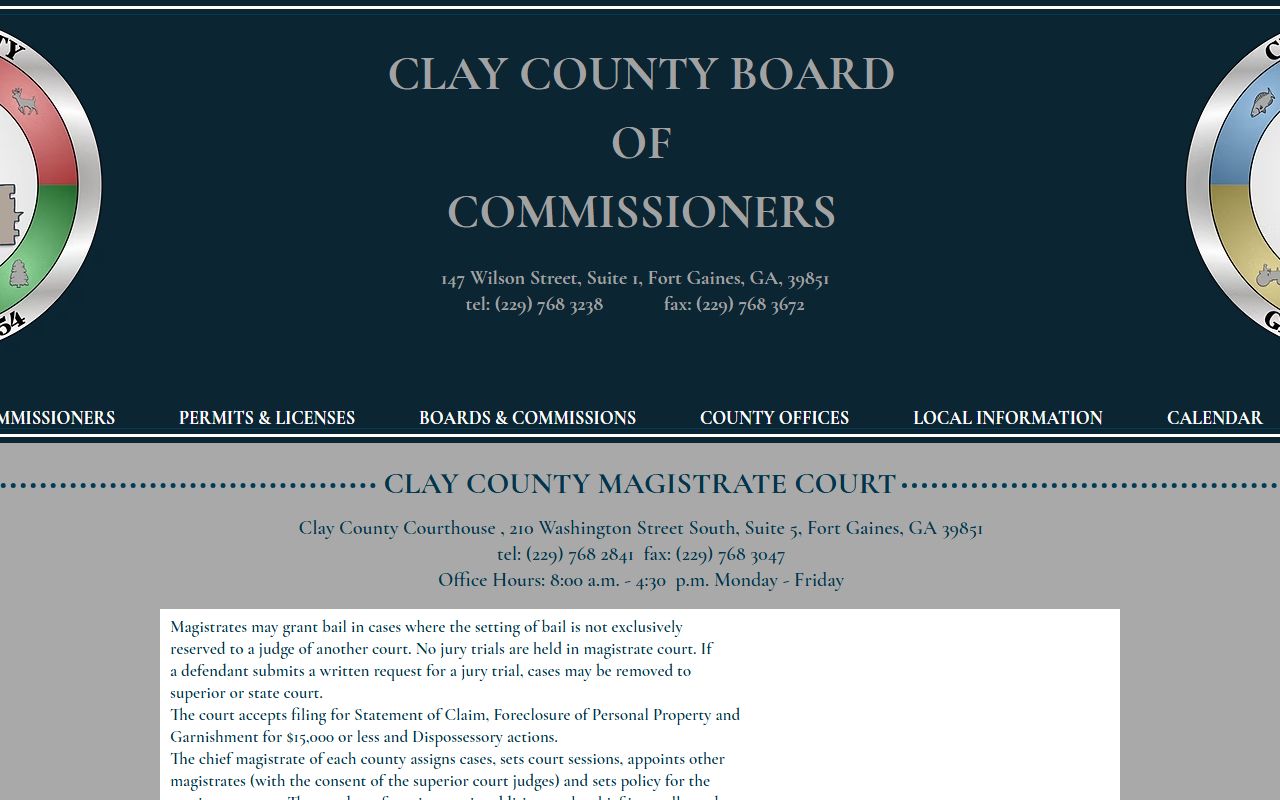
That court role explains why warrant questions may not be answered fully by a jail or inmate record alone.
Charges Versus Convictions
An arrest, charge, and conviction are three different events. A Clay County arrest means a person was taken into custody or processed on legal authority. A charge is an accusation shown in a booking report, warrant proceeding, accusation, indictment, or other court record. A conviction is a final outcome based on a plea or verdict. Court records after an arrest should be read with that sequence in mind.
| Charge | Conviction | |
|---|---|---|
| Stage | Accusation or filed count | Final plea or verdict reflected by the court |
| Proof Level | May begin with probable cause or prosecutor filing decision | Requires plea or proof beyond a reasonable doubt at trial |
| Custody Effect | Can affect bond, holds, hearings, and conditions | Can affect sentence, probation, fines, and criminal-history reporting |
| Public Record | Often public unless sealed, restricted, juvenile, or exempt | Often public unless restricted by law or court order |
Restricted Clay County Arrest Records
Georgia usually uses the term record restriction rather than ordinary expungement. The Georgia Bureau of Investigation record-restriction page and the Georgia.gov public guide describe how qualifying arrest records may be limited from public criminal-history access. Restriction is not the same as destroying every paper, court, or agency record. It can limit what appears to the public in criminal-history systems while some official access remains.
For arrests before July 1, 2013, Georgia.gov directs many applicants to begin with the arresting agency using the request-to-restrict arrest record form. For arrests on or after July 1, 2013, requests generally go to the prosecuting attorney. In Clay County felony matters, that means the Pataula Judicial Circuit prosecutor may have a review role. A denial may have an appeal path through Superior Court. The clerk, prosecutor, GBI, and arresting agency may each control a different part of the record trail.
| Restricted or Sealed | Expunged in Common Speech | |
|---|---|---|
| Georgia Term | Record restriction is the primary Georgia public-access term | Often used by the public, but Georgia rules are more specific |
| Visibility | Public criminal-history access may be limited for qualifying records | Does not always mean every court or agency record is destroyed |
| Agency Access | Law enforcement or courts may retain access under Georgia law | Depends on the exact record and legal order |
| Clay County Path | Arresting agency, prosecutor, GBI, and Superior Court may each matter | Start with the Georgia record-restriction process, not a mugshot site |
Clay County Open Records
The Georgia Attorney General Open Government materials explain the Open Records Act framework for public records held by Georgia agencies. The Governor's Office overview and Attorney General materials describe the common three-business-day response concept. That does not mean every Clay County jail, sheriff, prosecutor, or court record must be released within three business days. It means the custodian must respond within the legal framework, and exemptions, redactions, fees, and record location can affect the result.
For Clay County court records after an arrest, a narrow request is stronger than a broad one. Ask for a named record: docket entries, case number, accusation, indictment, bond order, disposition, warrant proceeding, or calendar entry. For sheriff-held records, ask for a booking report, bonding report, release record, or non-exempt warrant-service record. Juvenile matters, sealed cases, active investigations, restricted criminal-history information, victim information, and security-sensitive records can be withheld or redacted.
The Georgia Attorney General Open Government overview is the statewide source for the public-records framework that applies to Clay requests.
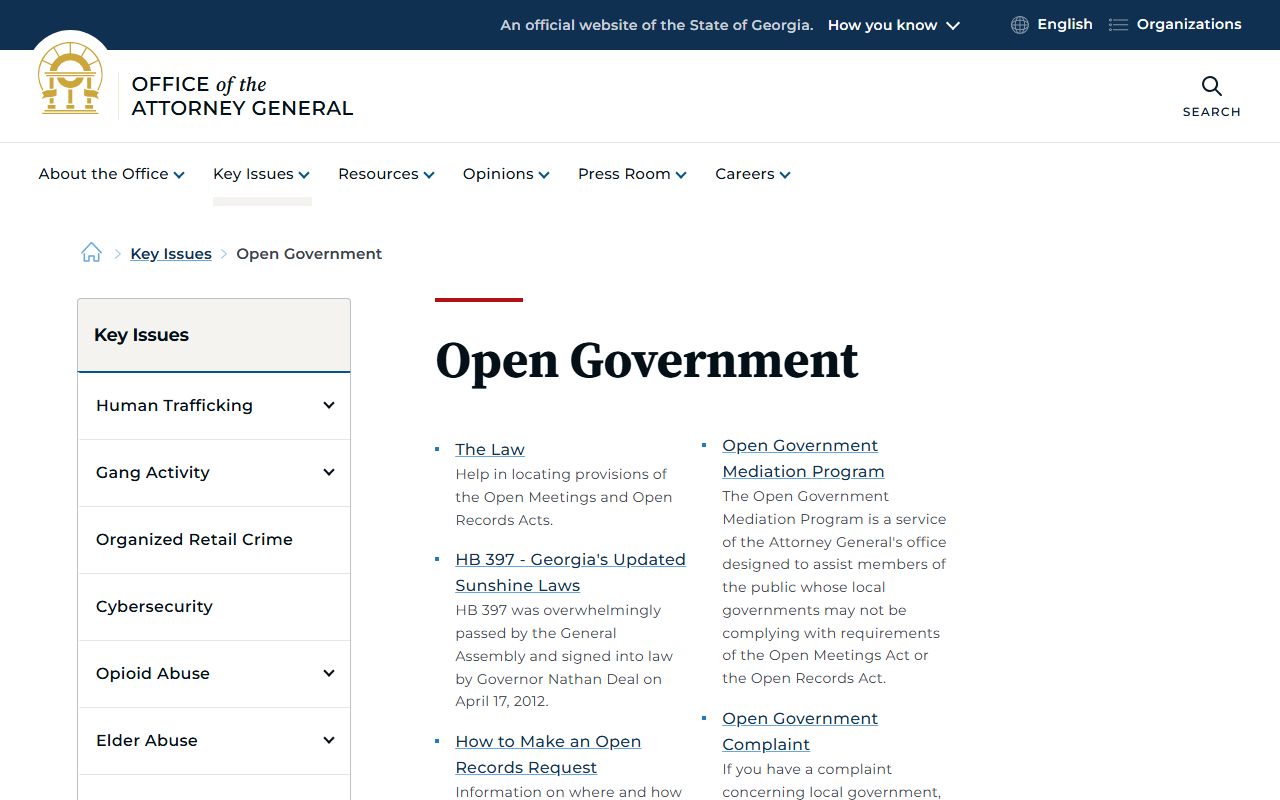
That framework supports records requests, but it does not turn a non-public Clay roster into an online court search.
Important: Clay County Inmate Population is not a consumer reporting agency and cannot be used for FCRA-covered screening decisions.
State and Federal Record Checks
A Clay County arrest can later move outside the local court or jail path. If a person is sentenced to state prison, use the Georgia Department of Corrections Offender Query. The GDC form includes name fields, demographics, most recent institution, offense, conviction county, active or inactive scope, and photo options. GDC lists Clay County Jail as an institution option, but GDC is not the live Clay County jail roster, and its help material warns that county-jail detail may be limited.
Federal custody has a separate path through the BOP Inmate Locator. Immigration detention uses the ICE Online Detainee Locator System. No BOP prison, ICE detention facility, or Georgia state prison was found inside Clay County in the official facility sources. If a Clay County search fails, that absence does not prove the person is free. It may mean the person was released, transferred, sentenced, booked under another name, held for another agency, or never booked by Clay County.